
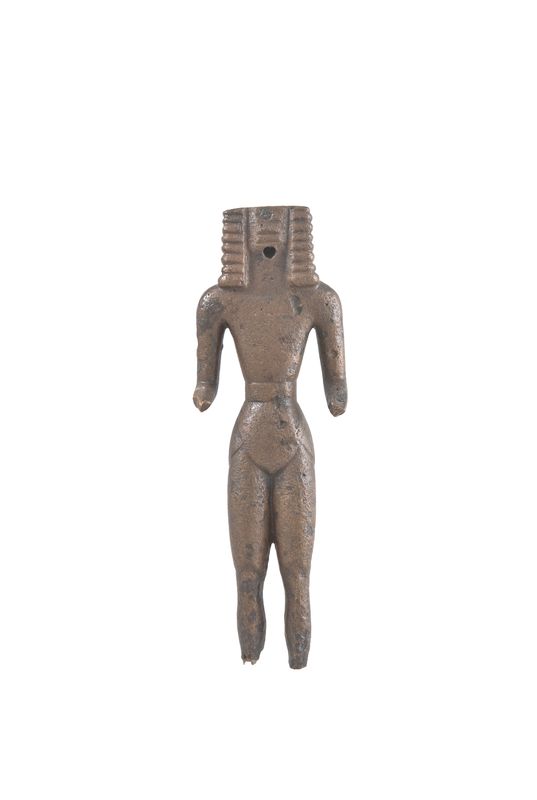
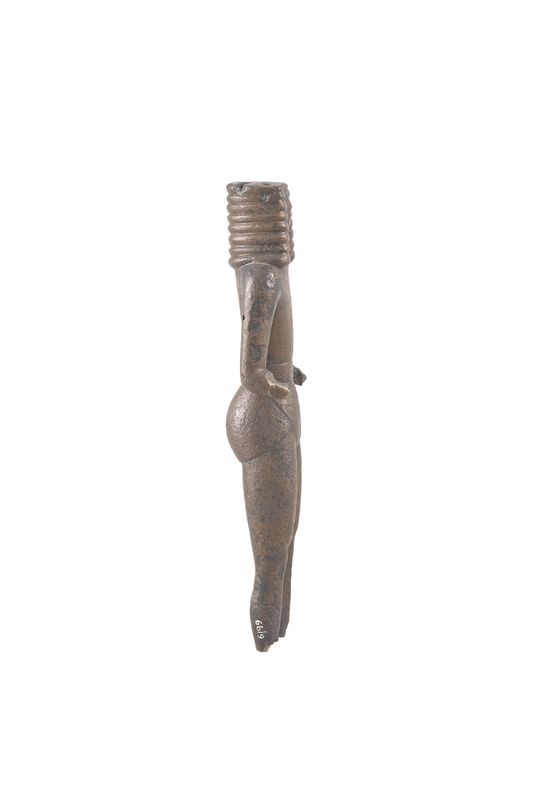
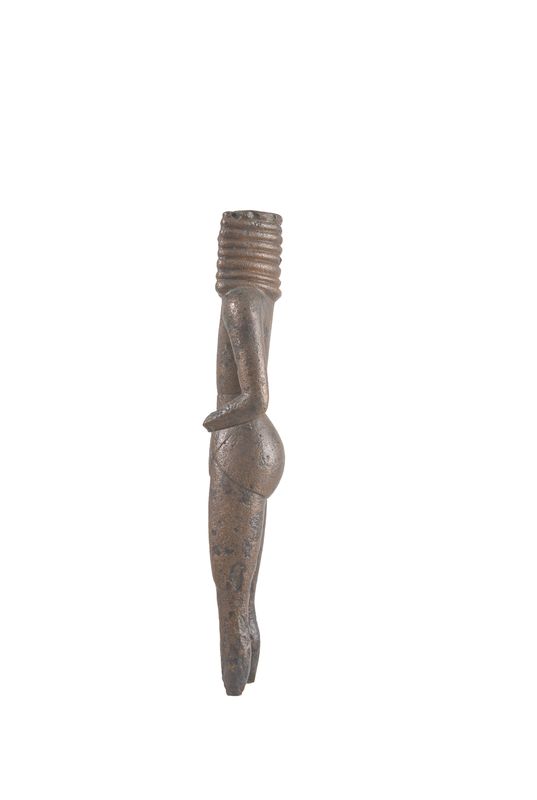
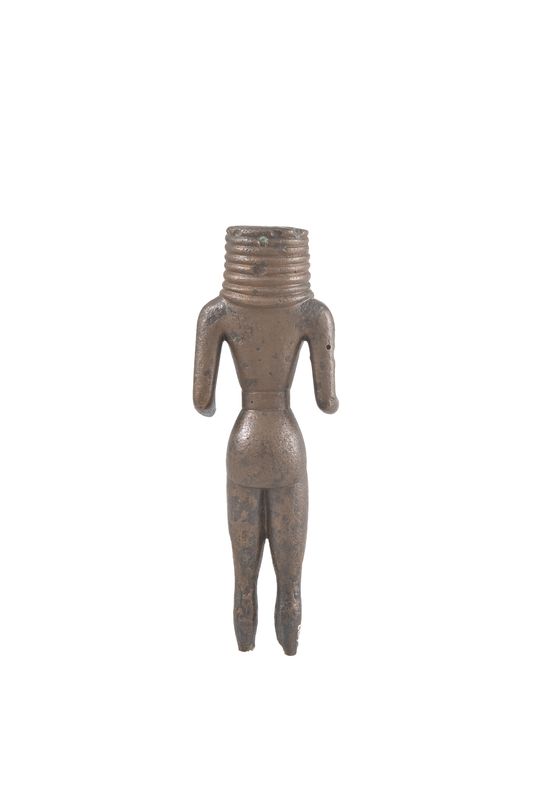
Fragmentarily preserved kourosfigurine. The man wears a short garment girded with a wide belt and his long hair is wavy. Beneath his chin is a deep circular hole. Six similar holes are retained on his flat head top. The ‘peculiar’ way in which the head has been worked indicates that its top, possibly covered with a helmet, as well as the facial characteristics, were inset, made separately in metal. We are not in position to know whether this technique was defined by the artist’s personal preference or some repair of the figurine.
De Ridder, A., Bronzes Trouvés sur l' Acropole d'Athènes, Paris, 1896, σελ. 243-244, εικ. 213, αρ.κατ. 696 Kaulen, G., Daidalika. Werkstätten griechescher Kleinplastik des 7. Jahrhunderts v. Chr., München, 1967, σελ. 35, εικ. 1-3 Fuchs, W., Floren, J., Die griechische Plastik, I: Die geometrische und archaische Plastik, München, 1987, σελ. 139 υποσημ. 79, αρ.κατ. 696 Rolley, Cl., La sculpture grecque. Des origines au milieu du Ve siècle, La sculpture grecque 1, Paris, 1994, σελ. 136 υποσημ. 25 Λεμπέση, Α., Tα ιερά του Ερμή και της Αφροδίτης στη Σύμη Bιάννου. Tα χάλκινα ανθρωπόμορφα ειδώλια, 3, Αθήνα, 2002, σελ. 109-111 υποσημ. 384, 161, 291, 293 υποσημ. 1375, εικ. 80 Scholl, A., «Die Akropolisvotive aus dem 8. bis frühen 6. Jahrhundert v.Chr. und die Staatswerdung Athens», Jahrbuch des Deutschen Archäologischen Instituts 121, 2006, σελ. 109-110, 164, εικ. 48a-b, αρ.κατ. 158 Παντερμαλής, Δ., Ελευθεράτου, Σ., Βλασσοπούλου, Χ., Μουσείο Ακρόπολης. Οδηγός, Αθήνα, 2016, σελ. 89-90, εικ. 94