
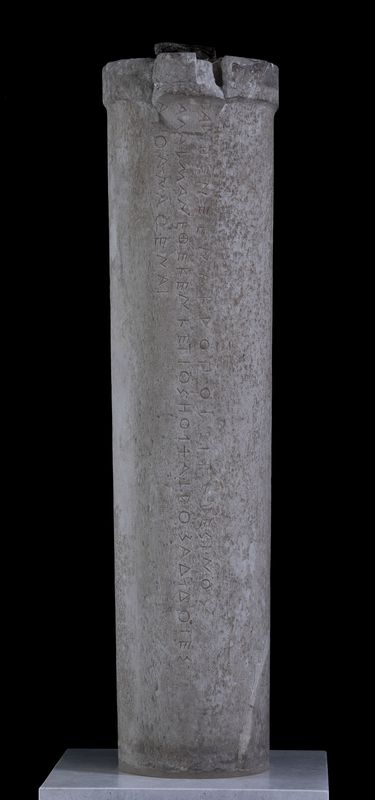
It has the form of a column without flutes that retains on its upper part a joint to support a bronze dedication of a horse or a rider. An inscribed epigram states: ΦΑΡΘΕΝΕ ΕΝ ΑΚΡΟΠΟΛΕΙ ΤΕΛΕΣΙΝΟΣ ΑΓΑΛΜ' ΑΝΕΘΕΚΕΝ ΚΕΤΙΟΣ, HΟΙ ΧΑΙΡΟΣΑ ΔΙΔΟΙΕΣ ΑΛΟ ΑΝΑΘΕΝΑΙ, meaning “Virgin goddess this statue was dedicated to the Acropolis by Telesinos from the municipality of Kettos. Give him the grace to offer you another one”.
According to the epigram Telesinos appeals to Athena Parthenos asking for her good grace so that he might be able to offer her another dedication in the future.
Friedlander, P., Epigrammata, Greek Inscriptions in Verse: From the Beginnings to the Persian Wars, 1948, σελ. 42, αρ.κατ. 39 Raubitschek, A.E., Dedications from the Athenian Akropolis. A Catalogue of the Inscriptions of the Sixth and Fifth Century BC, Cambridge Mass, 1949, σελ. 43, εικ. no. 40, αρ.κατ. 40 Κωνσταντίνου, I., Ρυθμός κινήσεων και λοξαί στάσεις στην αρχαία ελληνική πλαστική, Αθήνα, 1957, σελ. 23, εικ. 8 Μπρούσκαρη, Μ., Μουσείον Ακροπόλεως. Περιγραφικός κατάλογος, Αθήνα, 1974, σελ. 48, εικ. 85 Inscriptiones Graecae Ι3, αρ.κατ. 728 Τριάντη, Ι., Το Μουσείο Ακροπόλεως, Ο Κύκλος των Μουσείων, Αθήνα, 1998, σελ. 186 Hurwit, J.M., The Athenian Acropolis, History, Mythology and archaeology from Neolithic Era to the Present, Cambridge, 1999, σελ. 35-36, εικ. 32 Kissas, K., Die attischen Statuen- und Stelenbasen archaischer Zeit, Bonn, 2000, σελ. 232-233, αρ.κατ. Β 186 Ματθαίου, Α., Μαλούχου, Γ., Συνοπτικός κατάλογος των επιγραφών της Ακροπόλεως, Αθήνα, 2012, σελ. 7