
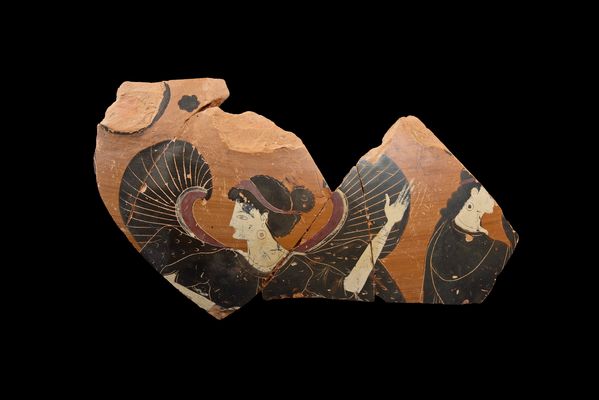
It forms part of a large vessel relating to wedding procedures, most likely a nuptial lebes. The larger and most recognisable vessel part is exhibited, while some smaller fragments are kept in the Museum’s storage units.
The showcased piece depicts a winged female figure with big, curving wings rising from her back. She has wavy hair gathered on the top of her head in a bun and a band encircling her head. She sports large, circular earrings on her ears and wears a chiton secured with fibulae over her shoulders, thus creating sleeves that reach her elbow. The figure is presented in the conventional running stance of the Archaic period, with the head and legs in profile and the torso rendered frontally. To her left, and with her back turned to her, stands a second female figure, also dressed in a chiton and with a band in her hair, which seems to be supporting an object on her head. The rest of the vase’s fragments bear the bended leg of the winged figure, the winged endromides belonging to god Hermes, a small part of a chariot and female figures.
This is clearly a wedding scene where the women carry trays with the gifts they will offer to the bride. Hermes stands next to the chariot in the role of a nymphagogos and the winged female is identified as the goddess Iris or Nike. Her presence possibly denotes divine intervention and protection given for the upcoming nuptials, as well as the bride’s “flight” towards her new life.