

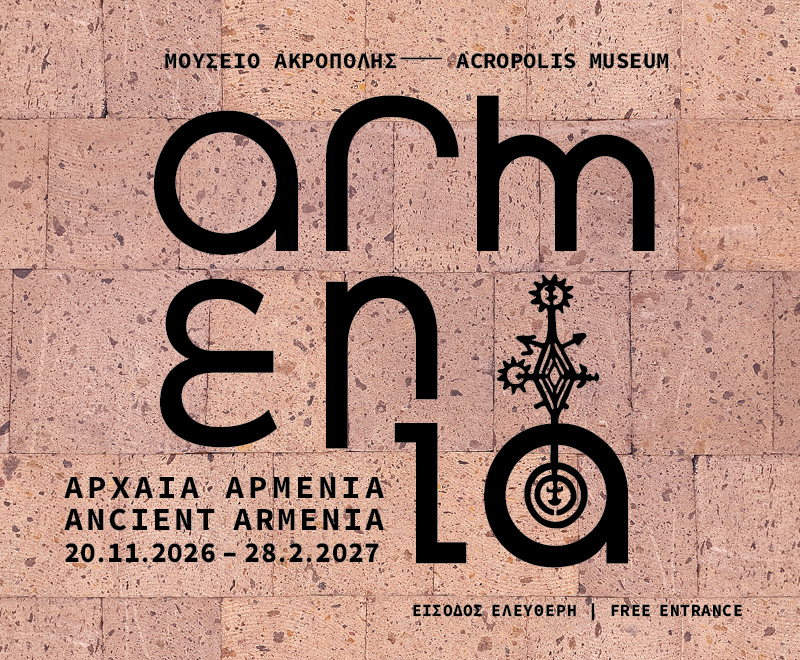
The Acropolis Museum will present the exhibition entitled "Ancient Armenia", from 20 November 2026 to 28 February 2027 in the Temporary Exhibition Gallery, the first of a series of exhibitions showcasing ancient civilizations. The Exhibition is organized by the Acropolis Museum with the History Museum of Armenia.
Armenia is known also from other major exhibitions, primarily for its Christian culture, whilst very little is known about the country and its civilization from the Palaeolithic period, the Bronze Age, the Early Iron Age, the Archaic, Classical, Hellenistic and Roman periods, right up to the dawn of Christianity in the 4th century AD.
The forthcoming Exhibition will comprise around 200 artifacts from all the aforementioned periods, with a focus on one of the most fascinating chapters of ancient Armenian civilization, that of the Urartu period, which opens ‘windows’ onto the civilizations of the Near East, the eastern Mediterranean, Cyprus, Crete and the Aegean during the Early Iron Age.
With the support of the Ministry of Education, Science, Culture and Sports of Armenia and the Embassy of Armenia in Greece.

IMAGES


VISITOR INFORMATION
DURATION
20 November 2026
28 February 2027
LOCATION
Temporary Exhibition Gallery, Museum's ground floor
TICKETS
Entrance to the exhibition is free. A free admission ticket is required from the Museum Ticket Desk.
Group visits (16 to 30 persons) can be arranged by sending a request at [email protected].
LANGUAGES
Greek and English signage.
GALLERY TALKS
The Acropolis Museum in its exhibition "Ancient Armenia" is presenting 198 works from the collections of the History Museum of Armenia, in combination with selected objects from Museums of Greece and Cyprus, which date from the prehistoric times and the civilization of Urartu to the Hellenistic and Medieval period.
Join the Museum’s archaeologist on a guided tour regarding a civilization of a remarkable historical trajectory, at one of the most important crossroads between the East and the Mediterranean.
Visitors can discover the complex routes that connected that area of Caucasus with the Near East, the Eastern Mediterranean, Cyprus, the Aegean and Crete, and the complex networks of cultural communication, exchange and interaction that were developed and demonstrate the active participation of Armenia in that broader world and in the intellectual and artistic blending that took place.
USEFUL INFORMATION
Friday 2Oth at 18:00
Saturday 21st at 18:00
Sunday 22nd at 12:00
Friday 27th at 18:00
Saturday 28th at 18:00
Sunday 29th at 12:00
December :
Friday 4th at 18:00
Sunday 6th at 12:00
Friday 11th at 18:00
Saturday 12th at 18:00
Friday 18th at 18:00
Saturday 19th at 18:00
Sunday 20th at 12:00
Sunday 27th at 12:00
To ensure your participation, a day ticket must be obtained by presenting your reservation code at the ticket counters marked 6, 7, and 8, up to 20 minutes before the program starts.
In case you need to cancel your participation, please inform us by phone at (+30) 210 9000900 or in writing at [email protected].
Group bookings (more than 10 persons) are not allowed
Presentations are carried out with the use of whisper guide system headsets provided at the Visitor Services Desk after delivering temporarily an official identification document (Identity Card, Passport or Driver's License)